
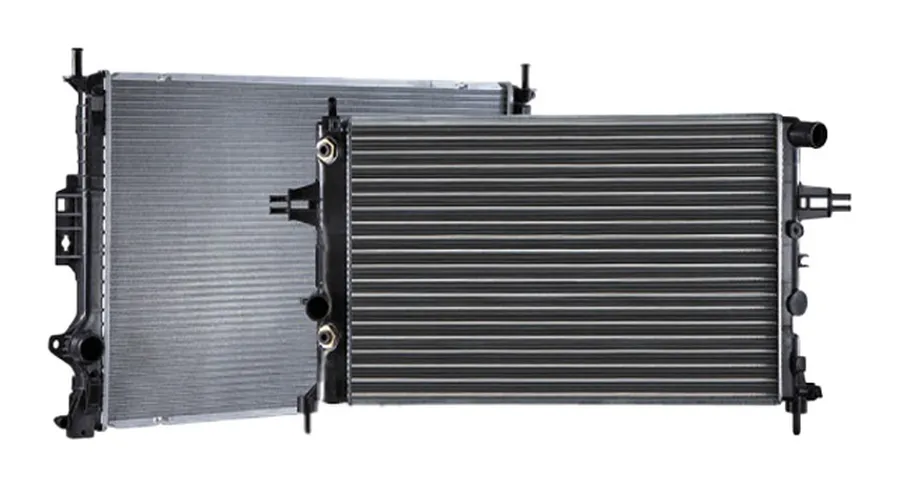
A radiator is the main heat exchanger of the engine cooling system. Hot coolant from the engine flows through a core of thin aluminium tubes fitted with fins; the air drawn through the core by the cooling fan, and by the motion of the car, carries the heat away, and the cooled coolant returns to the engine. Most passenger-car radiators are cross-flow units with a plastic tank crimped onto each side of the aluminium core; the tanks carry the hose connections, the mounting pins and, on many automatic vehicles, a gearbox oil cooler.
Radiators fail in two ways. The core corrodes from the outside, in road salt and dirt, and from the inside when the coolant is old and its inhibitors are spent; the thin tubes then weep. And the plastic tanks age with heat cycles until a crimp or a hose neck cracks. Both show as coolant loss and a temperature gauge that climbs when the car stands in traffic, where the airflow is lowest.
KRONTEK radiators are made to OEM-compliant quality and as aftermarket spare parts: the core dimensions, the tank connections and the mounting points of the original, so the radiator fits the original brackets, hoses and fan shroud.
The range covers European and Japanese passenger cars. Each reference is identified by the OE number of the original part; send that number and the vehicle identification number (VIN) and we confirm the matching KRONTEK reference.
For availability and OE cross-references, contact us by email.