
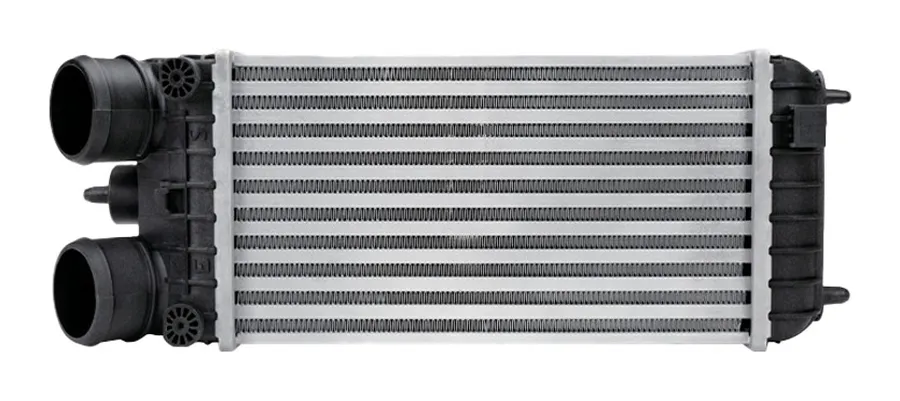
A turbocharger or supercharger compresses the intake air, and compression heats it. Hot air is less dense, so the engine takes in less oxygen per stroke than the boost pressure suggests, and hot charge air raises the risk of knock. The intercooler, or charge-air cooler, is the heat exchanger that solves this: the compressed air passes through a finned aluminium core mounted in the airflow, in front of the radiator or at the side of the engine bay, and reaches the engine cooler and denser.
The intercooler lives in the front of the car, where it takes stones, road salt and the pressure pulses of the boost. The plastic end tanks crack at the crimp or at a pipe connection, the core corrodes, and the hose joints let go. A leaking intercooler loses boost pressure: the engine loses power, the engine control unit logs a boost fault, and a hiss can be heard under load.
KRONTEK intercoolers are made to OEM-compliant quality and as aftermarket spare parts: the core size, the end tanks, the pipe connections and the mounting of the original, so the intercooler fits the original pipes and brackets.
The range covers European and Japanese passenger cars. Each reference is identified by the OE number of the original part; send that number and the vehicle identification number (VIN) and we confirm the matching KRONTEK reference.
For availability and OE cross-references, contact us by email.