
The short answer
The cap is a pressure valve. It holds the cooling system at about one to one and a half bar above the air outside, which lifts the boiling point of the coolant well past 100 °C; the expansion tank takes up the coolant as it expands and gives it back as the engine cools. A cap whose seal or spring has weakened lets the pressure go, the coolant boils in traffic, and the car overheats although the radiator, the thermostat and the pump are fine. It is the first and cheapest part to check.
Why the system is pressurised
“The coolant is kept at higher-than-atmospheric pressure to increase its boiling point.” HELLA gives the figures: “The cooling circuit is under pressures between 1.0 bar and 1.5 bar”, and at that pressure the coolant “does not boil at a temperature of 100 °C, but only between 115°C and 130°C.” Haynes uses the kitchen comparison: “the increase in pressure raises the coolant’s boiling point to beyond 100deg C, much like a pressure cooker means you can cook at very high temperatures without boiling the food.” The engine can therefore run at its designed temperature, with the thermostat opening “the connection to the radiator once the desired operating temperature is reached”, without the coolant turning to steam at the hottest spots around the cylinders.
What the cap does
The pressure is set by the cap, whether it sits on the radiator or on the expansion tank. Inside it a spring holds a seal closed; when the pressure reaches the rating printed on the cap, the seal lifts and “allowing more of the coolant to flow into the expansion tank”. Wikipedia describes the same relief: “Excess pressure is vented by allowing a little liquid to escape.” A second, smaller valve works the other way: as the engine cools and the coolant contracts, “this may be ‘sucked’ back into the main coolant circuit”, so no vacuum forms in the radiator and no hose collapses.
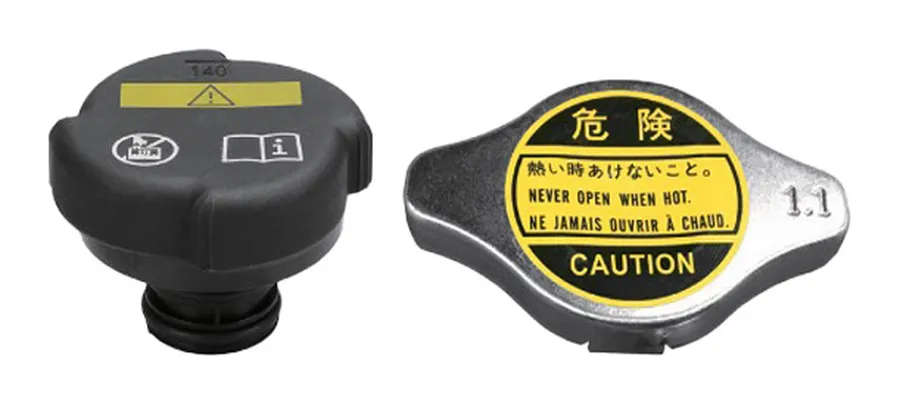
The number on the cap is that opening pressure. The 1.1 on the bayonet cap in the picture means 1.1 bar above atmospheric; other systems use 1.2, 1.4 or higher. A cap of the wrong rating is a real fault in both directions: too low, and the coolant boils early; too high, and every hose, the radiator tanks and the heater core carry a pressure they were not designed for.
What the expansion tank does
Coolant expands as it warms. On a modern car the expansion tank is a sealed part of the pressurised circuit, “which is only around half filled” so the extra volume has somewhere to go; on older designs an unpressurised bottle collects what the radiator cap vents and lets it return as the system cools. Either way the tank is the place where the level is read, on its min and max marks, with the engine cold.
Signs of a cap that no longer holds
| Sign | What is happening |
|---|---|
| Boiling over in traffic, coolant pushed out of the overflow, but the temperature normal on the open road | The cap no longer holds its rated pressure, so the coolant boils at a lower temperature when the airflow is lowest |
| A crust of dried coolant around the cap or the neck of the tank | The seal is leaking coolant or steam under pressure |
| A top hose that collapses as the engine cools | The return valve in the cap is stuck and a vacuum forms in the system |
| The cap turns freely or its seal is cracked and hard | Worn out; replace with the rating of the original |
Because the cap is inexpensive, it is replaced whenever a cooling-system fault is being chased, and always when the expansion tank is renewed: the neck and the seal wear together.
Safety
A hot cooling system is under that same pressure. “Always ensure the engine is cool before you open the filler cap – pressurised hot water can build up inside.” If a cap must come off warm, it is opened slowly, through a thick cloth, with the face away from it.
KRONTEK supplies radiator and expansion-tank caps, expansion tanks and radiators for European and Japanese passenger cars, identified by OE reference.