
The short answer
An air conditioning that blows warm has almost always lost refrigerant, and refrigerant does not wear out: it leaks. The condenser, in front of the radiator, is the most exposed part and the most common leak. A regas restores the cold air for a while, but a system that needs regassing every summer has a leak to find, and every time the circuit is opened for a repair the receiver drier is renewed as well.
How the circuit cools the cabin
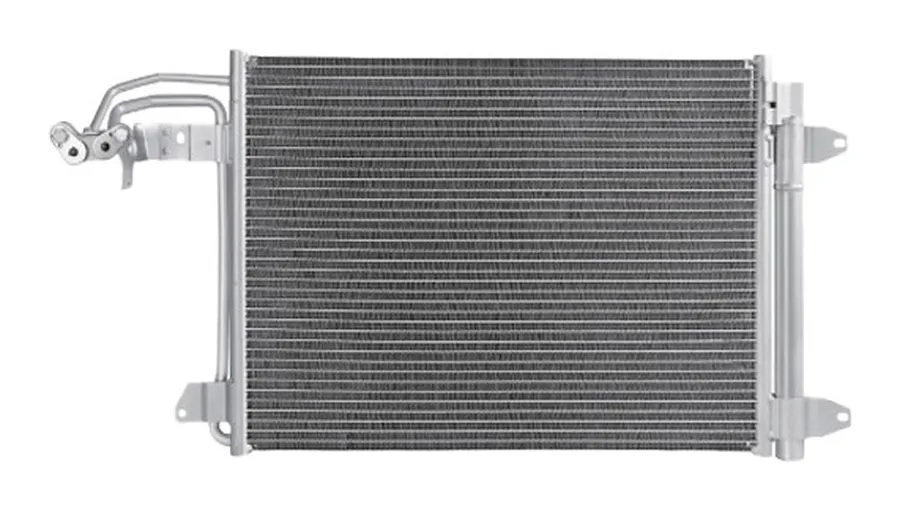
The air conditioning is a refrigeration cycle in five parts. The compressor in the engine bay “compresses the refrigerant gas vapor to a higher pressure”. The hot gas “is routed through a condenser, usually in front of the car’s radiator”, where “the refrigerant is cooled by air flowing across the surface” and turns back into a liquid. The liquid then passes “through the receiver-drier, that is, a one-way desiccant and filter cartridge that both dehydrates the refrigerant” and filters it. At the expansion valve it “undergoes an abrupt reduction in pressure. That pressure reduction results in flash evaporation of a part of the liquid refrigerant”, and the cold mixture goes “through the evaporator coil in the passenger compartment”, where the cabin air blown across it “is therefore cooled”. The moisture in that air condenses on the evaporator and drains under the car, which is why the air conditioning also demists the windscreen: “The air coming out of the vents is dry, so the air-con acts as a dehumidifier.”
Why it blows warm
“The first sign that your air-con needs regassing is that the air being blown from the vents is not as cool as it used to be.” The circuit is sealed, and in a healthy system the losses are small; Wikipedia advises that “the system should be checked for any loss in a two to four year circle”, and the RAC notes that “most manufacturers recommend you service your car’s air-con every two years or so.” When the pressure falls too far, a switch holds the compressor off to protect it, and the vents blow at cabin temperature.
A regas, “the process of removing the old refrigerant gas from your air conditioning system and replacing it with new refrigerant”, restores the charge. It does not repair the reason the charge was lost. That is why the specialist should “perform a vacuum test to check for any cracks or leaks that could prevent your air-con working in the future”: a system that holds vacuum is tight; one that does not has a leak, and “it’s possible your system may have a leak” is the first thing to rule out before paying for a second regas.
Where it leaks
| Symptom | Likely cause | Part |
|---|---|---|
| Cold air fades over one or two summers, no visible damage | Slow loss through ageing seals and O-rings | Seals, renewed with the drier |
| Sudden loss after a long journey on gravel or in winter salt; oily dirt on the front of the core | Stone damage or corrosion of the thin tubes in front of the radiator | Condenser |
| Loss with no leak found in the engine bay; oily film at the water drain under the car; a sweet smell at the vents | Corroded core inside the heater box | Evaporator |
| Cold air comes and goes; ice forms at the expansion valve | Moisture in the circuit, a saturated drier | Receiver drier |
| Air is cold but hardly any comes out of the vents | Blower speed control has failed, or the cabin filter is blocked | Blower resistor or regulator |
The condenser leads the list because of where it lives: it is the first thing behind the grille, its tubes are thinner than a radiator’s, and it takes every stone and every winter’s salt before the radiator does.
Why the drier is renewed with every repair
“Receiver driers are there to absorb corrosion-causing moisture and to filter any particulates that are circulating around the system.” The desiccant inside has a limited capacity, and once the circuit has been open to the air it is spent: “Once totally saturated, the drying agent in the drier turns to mush and circulates around the system.” Delphi’s rule is therefore that “the receiver drier should be changed every 2 years as part of a routine service” and that “if any component is replaced due to damage, the drier should also be replaced.” Moisture left in the circuit does lasting harm: “If moisture has been present in a system for a period of time, rust could form on any metal parts.”
Two habits that keep the system alive
Run it all year. “An air-con system is much like the human body – if not used for long periods it can seize up, plus circulation suffers”: the refrigerant carries the oil that lubricates the compressor and keeps the seals soft, and it only circulates when the system runs. And change the cabin filter regularly, so the evaporator gets its airflow and stays dry.
Refrigerants have changed as well. Cars built up to the mid-2010s use R-134a, whose “global warming potential number is about 1,430”; newer cars use R-1234yf, “the best for the environment with the lowest global warming potential number which is about 4”. The two are not interchangeable, and the label under the bonnet says which the car takes.
KRONTEK supplies condensers, evaporators, receiver driers, heater cores and blower resistors and fan control modules for European and Japanese passenger cars, identified by OE reference.